Why It Helps to Know Betting Terms
Whether you are placing your first bet or moving from casual punting into more structured strategies, the language of betting can feel like a foreign dialect. Bookmakers, exchanges, and tipsters use a specific vocabulary that is rarely explained — and misunderstanding a single term can lead to placing the wrong bet or misreading odds entirely.
This guide is designed to explain betting terms clearly and completely, covering everything from basic odds formats to exchange-specific language, promotional terminology, and strategy concepts. Each section groups related terms together so you can find what you need quickly, and the quick-reference glossary at the end brings the most common terms into one place.
Bookmark this page. You will come back to it.
Odds and Probability Terms
Odds are the foundation of every bet. Before anything else, it is essential to explain betting odds terms — because the format odds are displayed in varies by region and platform.
Fractional Odds
The traditional UK format. Written as two numbers separated by a slash, such as 5/1 (spoken as “five-to-one”). The first number is your profit if you stake the second number.
Example: A £10 bet at 5/1 returns £50 profit plus your £10 stake = £60 total.
Decimal Odds
The standard format on European bookmakers and all betting exchanges. The number represents your total return per £1 staked, including your stake.
Example: Odds of 6.00 on a £10 bet = £60 total return (£50 profit + £10 stake).
To convert fractional to decimal: divide the fraction and add 1. So 5/1 = (5 ÷ 1) + 1 = 6.00.
American (Moneyline) Odds
Common in the United States. Positive odds (+200) show profit on a £100 stake. Negative odds (−150) show how much you must stake to win £100.
Implied Probability
The likelihood of an outcome occurring, as suggested by the odds. To calculate it from decimal odds: divide 1 by the odds.
Example: Odds of 4.00 → 1 ÷ 4.00 = 0.25 = 25% implied probability.
Overround (Vig / Juice)
The bookmaker’s built-in margin. When you add up the implied probabilities of all outcomes in a market, they exceed 100%. The excess is the overround — the house edge that ensures the bookmaker profits over time regardless of the result.
Even Money (Evens)
Odds of 1/1 in fractional format, or 2.00 in decimal. A winning bet returns exactly double your stake — profit equal to the amount wagered.
Odds-On
When the odds are shorter than evens — meaning you must stake more than you stand to win. For example, 1/2 (decimal 1.50) means a £10 bet returns only £5 profit. Odds-on selections are considered likely to win.
Bet Type Terms
Once you understand odds, the next step is to explain betting terms related to the types of bets available. These range from simple single selections to complex multi-bet combinations.
Single
The simplest bet: one selection, one outcome. Your stake is on one event and if it wins, you collect at the stated odds.
Accumulator (Acca)
A bet combining multiple selections into one wager. All selections must win for the bet to pay out. The odds multiply across each leg, creating the potential for large returns from a small stake — but with correspondingly higher risk.
Example: A four-fold accumulator at odds of 2.00, 3.00, 2.50, and 1.80 gives combined odds of 2.00 × 3.00 × 2.50 × 1.80 = 27.00. A £10 bet returns £270.
Each-Way (EW)
A bet split into two equal parts: one backing the selection to win, and one backing it to place (finish in the top two, three, or four depending on the market). Common in horse racing and golf.
If the selection wins, both parts pay out. If it places but does not win, only the place part of the bet is paid — at a fraction of the win odds (typically 1/4 or 1/5).
Double
Two selections combined. Both must win. Simpler than an accumulator but still requires both results to go your way.
Treble
Three selections combined. All three must win.
Trixie
Three selections producing four bets: three doubles and one treble. Requires at least two selections to win for a return.
Patent
Seven bets from three selections: three singles, three doubles, and one treble. A single winner guarantees some return.
Yankee
Eleven bets from four selections: six doubles, four trebles, and one four-fold accumulator. No singles included — requires at least two winners for a return.
Lucky 15
Fifteen bets from four selections: four singles, six doubles, four trebles, and one four-fold. The most popular multiple bet in horse racing.
System Bets
Bets that cover multiple combinations of selections so that not all need to win for a partial or full return. Trixie, Patent, Yankee, and Lucky 15 are all forms of system bets.
Handicap Bet
A bet where one team or competitor is given a virtual advantage or disadvantage to level the playing field. Common in football, rugby, and American sports.
Example: Team A −1.5 means Team A must win by two or more goals for the bet to pay out.
Asian Handicap
A more refined version of handicap betting with no draw option, eliminating the possibility of a push (void bet). Quarter-ball and half-ball handicaps create fractional outcomes.
Spread Betting
A form of wagering where profit or loss is determined by how right or wrong your prediction is, not just whether you win or lose. Positions are sized by a unit stake, and results are calculated by multiplying that stake by the margin of victory or defeat. Spread betting involves potentially unlimited losses and is regulated differently from fixed-odds betting.
In-Play (Live) Betting
Placing bets after an event has already started. Odds update in real time based on what is happening on the field. Available at most major bookmakers and exchanges.
Exchange Betting Terms
Betting exchanges operate differently from bookmakers. To explain betting terms specific to exchanges, it helps to understand that on an exchange, you are betting against other users — not against the house.
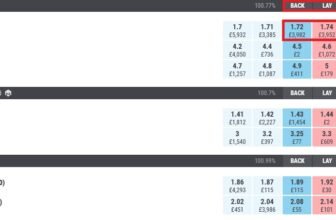
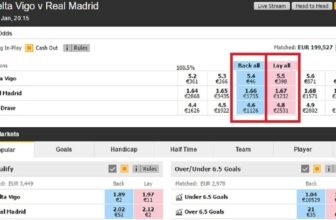
Back Bet
Betting that an outcome will happen. Equivalent to a standard bet at a bookmaker. You win if your selection is correct.
Lay Bet
Betting that an outcome will not happen. You act as the bookmaker, accepting another bettor’s back bet. If the selection loses, you keep their stake. If it wins, you pay out their winnings.
Liability
The maximum amount you stand to lose on a lay bet. Calculated as: Lay Stake × (Lay Odds − 1). Higher odds create higher liabilities.
Matched Bet
A bet that has been fully accepted by the opposite side on an exchange. An unmatched bet sits in the queue until another user takes the other side or the odds move.
Green Up
Locking in a profit on all outcomes before an event ends by backing and laying the same selection at different odds. Achieved through in-play trading on an exchange.
Commission
The fee charged by the exchange on net winnings in each market. Typically 2–5%. This replaces the overround that traditional bookmakers build into their odds.
Premium Charge
An additional fee applied by Betfair to consistently profitable customers who have generated high lifetime winnings. Affects a small percentage of the most successful users.
Bookmaker and Market Terms
Bookmaker (Bookie)
A licensed operator that accepts bets and pays out winnings. Sets its own odds and manages risk by adjusting those odds based on betting patterns.
Market
A specific event or outcome on which bets can be placed. For example, “Match Result”, “Both Teams to Score”, or “Top Goalscorer” are all separate markets within one football fixture.
Line
Another term for the odds or spread on a market. “The line” on a game refers to the current odds being offered.
Price
Slang for odds. “Getting a good price” means securing better-than-expected odds on a selection.
Stake
The amount of money placed on a bet.
Return
The total amount paid out if a bet wins, including both the profit and the original stake.
Void Bet
A bet that is cancelled and the stake returned, usually due to an event being abandoned, a palpable error in the odds, or specific rule triggers. Common in horse racing when a runner is withdrawn.
Rule 4 Deduction
In horse racing, when a horse is withdrawn after the market has opened, bookmakers apply a Rule 4 deduction to reduce winnings on remaining runners proportionally. The deduction percentage depends on the withdrawn horse’s odds.
Palpable Error
An obvious mistake in the odds set by a bookmaker. Bookmakers reserve the right to void bets placed on clearly erroneous prices.
Limits (Account Restriction)
When a bookmaker restricts the maximum stake a customer can place, usually because the customer has been identified as a sharp or profitable bettor. A common consequence of matched betting or arbitrage activity.
SP (Starting Price)
The official odds at the moment a race begins, as returned by the track. Bettors who take SP receive whatever odds are available at the off rather than locking in a price in advance.
Horse Racing Betting Terms
Horse racing has some of the most specialised vocabulary in betting. Here we explain betting terms that are unique or most commonly used in racing markets.
Each-Way Terms
As explained above — a bet on a horse to win and to place. The number of places paid and the fraction of odds offered vary by race size and bookmaker.
Win Only
A bet placed solely on a horse to finish first. If it places but does not win, the bet loses.
Non-Runner (NR)
A horse that was declared to run in a race but is withdrawn before the off. Bets on non-runners are usually voided and stakes returned, subject to Rule 4 deductions on other selections.
Going
The condition of the ground on a racecourse, ranging from Firm to Heavy. Horses often perform differently depending on going, making it a key factor for bettors.
Form
A horse’s recent race history, displayed as a string of results (e.g., 1-2-1-3). Used to assess likely performance in an upcoming race.
Ante-Post
Bets placed well in advance of an event — sometimes weeks or months before the race. Ante-post prices are often more generous, but stakes are usually lost if the selection does not run (no non-runner money back).
Tote
A pool betting system operated by the racecourse rather than a fixed-odds bookmaker. All bets on an outcome are pooled, and the payout is determined by the total pool divided by the number of winning tickets, minus a deduction for the operator.
Football Betting Terms
1X2
The standard match result market. 1 = home win, X = draw, 2 = away win.
Both Teams to Score (BTTS)
A market where you bet on whether both teams will score at least one goal during the match. Independent of the final result.
Over/Under Goals
A market based on the total number of goals in a match. The most common line is Over/Under 2.5 goals. Betting Over 2.5 wins if three or more goals are scored.
Correct Score
Predicting the exact final scoreline of a match. High-odds market due to the difficulty of accuracy.
Double Chance
A bet covering two of the three possible match results in one wager — for example, Home or Draw. Lower odds than a straight 1X2 bet but greater chance of winning.
Draw No Bet (DNB)
If the match ends in a draw, the stake is returned. You win if your chosen team wins and lose only if the opposing team wins.
Half-Time/Full-Time (HT/FT)
Predicting the result at both half-time and full-time. A nine-outcome market with higher odds than a standard match result bet.
First Goalscorer / Anytime Goalscorer
Betting on a specific player to score either the first goal of the match or at any point during the game.
Strategy and Value Terms
Value Bet
A bet where the odds offered are higher than the true probability of the outcome. If a bookmaker prices an event at 3.00 but you believe the true probability is 40% (equivalent to odds of 2.50), there is value in taking the 3.00.
Expected Value (EV)
A mathematical measure of the average profit or loss per bet over time. Positive EV (+EV) means the bet is expected to be profitable in the long run. Negative EV (−EV) means the bookmaker has the edge.
Sharp Bettor (Sharp)
A sophisticated, professional-level bettor who consistently finds value and bets to win. Sharps are often limited or banned by bookmakers. Also called a “wise guy.”
Square Bettor (Mug)
A recreational bettor who bets based on preference or gut feeling rather than analysis. Bookmakers welcome square bettors as they drive profit.
Staking Plan
A method of deciding how much to bet on each selection. Common plans include flat staking (same amount every bet), percentage staking (a fixed percentage of the bankroll), and the Kelly Criterion (staking proportional to your edge).
Bankroll Management
The discipline of managing your total betting funds to avoid ruin during losing runs. A core concept for any serious bettor.
Closing Line Value (CLV)
Whether the odds you took at the time of your bet were better than the odds available at the start of the event. Consistently beating the closing line is one of the strongest indicators of long-term profitable betting.
Matched Betting
A strategy that uses back and lay bets to extract guaranteed profit from bookmaker free bets and promotions, regardless of the sporting outcome. To use an exchange effectively, you must understand the mechanics of what is back and lay in betting.
Arbitrage (Arb)
Placing bets on all outcomes of an event across different bookmakers to guarantee a profit from odds discrepancies. Legal but likely to result in account restrictions. While many beginners ask is arbitrage betting legal, the reality is that it is a legitimate math-based strategy, though it may lead to account limits.
Account and Promotion Terms
Welcome Bonus
An introductory offer for new customers, typically a matched free bet or deposit bonus. Subject to wagering requirements.
Free Bet
A promotional stake provided by a bookmaker. Winnings from a free bet are paid without returning the stake itself (free bet stake not returned, or FBNSR).
Wagering Requirements (Rollover)
The number of times a bonus must be bet before winnings can be withdrawn. A £20 bonus with a 5x rollover must generate £100 in total bets before withdrawal is permitted.
Reload Bonus
A promotional offer for existing customers, typically a smaller free bet or deposit match tied to a specific event or day.
Cashout
A feature offered by most bookmakers allowing you to settle a bet before the event ends — taking a partial or full return based on the current state of play. Useful for securing profit or limiting losses.
Best Odds Guaranteed (BOG)
A promotion common in UK horse racing. If the starting price of your selection is higher than the price you took when placing the bet, the bookmaker pays out at the higher SP.
Enhanced Odds (Price Boost)
A promotional offer where a bookmaker temporarily increases the odds on a specific selection above their standard price. Usually restricted to one bet per customer.
Quick-Reference Glossary
For fast lookups, here are the most commonly searched betting terms in brief:
| Term | Meaning |
|---|---|
| Accumulator | Multiple selections combined; all must win |
| Ante-Post | Bet placed long before an event |
| Asian Handicap | Handicap bet with no draw option |
| Bankroll | Your total betting funds |
| Cashout | Settling a bet before the event ends |
| Each-Way | Bet split between win and place |
| Even Money | Odds of 2.00 — profit equals stake |
| Form | Recent race or match history |
| Going | Horse racing ground condition |
| Green Up | Locking in profit on an exchange |
| Handicap | Virtual advantage/disadvantage applied to a selection |
| Implied Probability | Likelihood suggested by the odds |
| In-Play | Betting after an event has started |
| Lay Bet | Betting an outcome will not happen |
| Liability | Maximum loss on a lay bet |
| Odds-On | Odds shorter than evens |
| Overround | Bookmaker’s built-in margin |
| Palpable Error | Obvious mistake in odds |
| Rule 4 | Deduction applied when a runner withdraws |
| SP (Starting Price) | Official odds at the start of a race |
| Stake | Amount wagered |
| Value Bet | Bet where odds exceed true probability |
| Void | Cancelled bet — stake returned |
FAQs
What is the easiest way to explain betting terms to a beginner?
Start with three concepts: odds (the price), stake (the amount you risk), and return (what you get back if you win). Once those are clear, layer in bet types — singles first, then accumulators — before moving into more advanced terms like handicaps, exchanges, and value betting.
What does “each-way” mean in betting?
Each-way means your bet is split into two equal parts — one on your selection to win, and one on it to finish in a placed position (usually top two, three, or four). If it wins, both parts pay. If it only places, you receive a reduced return based on a fraction of the win odds.
What does “laying” a bet mean?
Laying means betting against an outcome — acting as the bookmaker and accepting another bettor’s wager. If the selection loses, you keep their stake as profit. If it wins, you pay out their winnings. Lay bets are only available on betting exchanges.
What is the overround in betting?
The overround is the bookmaker’s profit margin, built into their odds. If you add up the implied probabilities of all outcomes in a market, they exceed 100%. That excess — sometimes 5–15% in most markets — is the overround, and it ensures the bookmaker has a statistical edge on every market.
What is a value bet?
A value bet is one where the odds offered by the bookmaker are higher than the true probability of the outcome occurring. Over time, consistently finding and placing value bets is the only reliable way to generate long-term profit from betting.
What does SP mean in horse racing?
SP stands for Starting Price — the official odds returned at the moment a race starts. Bettors who choose to take SP receive these odds rather than an early price taken before the race.
What is the difference between decimal and fractional odds?
Fractional odds (e.g. 5/1) show profit relative to stake. Decimal odds (e.g. 6.00) show total return per £1 staked, including the stake itself. Decimal odds are more common on exchanges and European bookmakers; fractional odds remain standard at UK high street bookmakers.
Conclusion
Betting has its own language, and understanding it puts you in a significantly stronger position before you place a single pound. This guide has aimed to explain betting terms across every major category — from basic odds formats and bet types through to exchange mechanics, horse racing vocabulary, football markets, and strategy concepts.
The most important terms to master first are odds formats, stake and return, each-way bets if you follow racing, and the difference between back and lay if you plan to use exchanges or matched betting. Everything else builds from there.
Return to this glossary whenever you encounter an unfamiliar term, and use the quick-reference table for fast lookups mid-session.