If you’ve ever asked what is exchange in betting, you’re not alone. Betting exchanges have transformed the gambling industry over the past two decades, giving bettors a smarter, more flexible, and often more profitable way to bet. This comprehensive guide explains everything you need to know about betting exchanges — from how they work to how to profit from them.
What Is Exchange in Betting?
A betting exchange is an online platform that allows bettors to bet directly against each other, rather than betting against a bookmaker. In exchange betting, one person backs an outcome (bets it will happen) while another person lays the same outcome (bets it won’t happen). The betting exchange simply acts as the intermediary marketplace, matching these opposing bets and taking a small commission on winning trades.
In simple terms, a betting exchange is like a stock market for sports bets. Just as buyers and sellers set prices on a stock exchange, bettors on a betting exchange set their own odds and wait for someone to match them.
This peer-to-peer model is what fundamentally separates a betting exchange from a traditional sportsbook. When you understand what exchange in betting means, you realize it gives bettors unprecedented power to both back and lay selections — opportunities that traditional bookmakers simply cannot offer.
Key definition: A betting exchange is a marketplace where bettors trade directly with one another, with the exchange platform facilitating the transaction and charging a commission on net winnings.
How Does a Betting Exchange Work?
Understanding how a betting exchange works is essential before placing your first trade. The mechanism is straightforward once you grasp the two core roles in exchange betting:
The Two Sides of Every Exchange Bet
1. The Backer A backer believes an outcome will happen. For example, if you back Manchester United to win at odds of 2.5, you win profit if Manchester United wins. This is the same concept as placing a traditional bet with a bookmaker.
2. The Layer A layer believes an outcome will NOT happen. If you lay Manchester United to win at odds of 2.5, you are effectively acting as the bookmaker. You collect the backer’s stake if Manchester United fails to win, but you pay out winnings if they do win.
The Matching Process
When you place a bet on a betting exchange, the platform searches for another bettor willing to take the opposite side at the same odds. Once matched, the bet is confirmed. Here is how the process works step by step:
- You visit a betting exchange and select a market (e.g., Premier League match)
- You choose to back or lay a selection
- You enter your desired odds and stake
- The exchange matches your bet with another user offering opposing odds
- If matched, funds are held in escrow by the exchange
- After the event, winnings are distributed and the exchange deducts commission
If no matching bet is available at your requested odds, your bet sits in the market as an unmatched bet until another user accepts it, or until you cancel it.
Betting Exchange vs Traditional Bookmaker
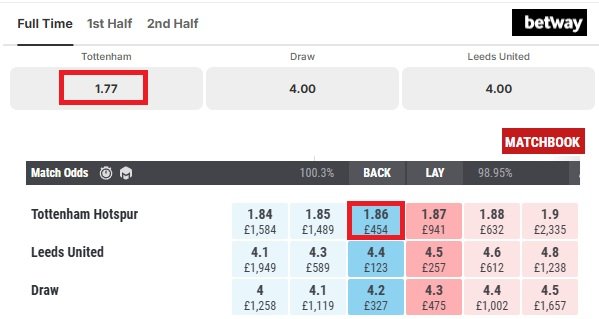
One of the most common questions from new bettors is: what is the difference between a betting exchange and a traditional bookmaker? The differences are significant and affect everything from how odds are set to how much profit you can realistically make.
| Feature | Betting Exchange | Traditional Bookmaker |
|---|---|---|
| Who you bet against | Other bettors | The bookmaker |
| Odds setter | Bettors (market-driven) | Bookmaker |
| Ability to lay bets | Yes | No |
| Profit model | Commission on winnings | Built-in margin (overround) |
| Odds value | Generally better | Includes bookmaker’s margin |
| Account restrictions | Rare | Common for winning bettors |
| In-play betting | Extensive | Limited |
| Transparency | High | Low |
Why Betting Exchanges Offer Better Odds
Because a betting exchange does not need to build a profit margin into every price, the odds available on an exchange are almost always better than those at a traditional bookmaker. The bookmaker’s overround — the built-in profit percentage — is replaced on a betting exchange by a transparent commission charge, which typically amounts to less than the bookmaker’s margin on high-volume markets.
Back Betting vs Lay Betting Explained
The concept of back and lay betting is central to understanding what exchange in betting really means. These two positions define every transaction on a betting exchange.
What Is Back Betting?
Back betting on a betting exchange is identical in concept to placing a traditional bet. You back a selection to win. If your selection wins, you receive your stake multiplied by the odds. If your selection loses, you lose your stake.
Example of a back bet:
- Selection: Liverpool to win
- Odds: 2.00
- Stake: £50
- If Liverpool wins: You receive £100 (£50 profit + £50 stake back)
- If Liverpool loses or draws: You lose £50
What Is Lay Betting?
Lay betting is unique to betting exchanges and is one of the most powerful features of exchange betting. When you lay a selection, you are betting that the outcome will NOT happen. You are effectively taking the role of the bookmaker.
Example of a lay bet:
- Selection: Liverpool to win (you are laying this)
- Lay odds: 2.00
- Backer’s stake: £50
- Your liability: £50 (the amount you pay if Liverpool wins)
- If Liverpool does NOT win (draw or loss): You collect £50
- If Liverpool wins: You pay out £50
Lay Liability Explained
The most important concept in lay betting is lay liability. Unlike backing, where you only risk your stake, laying requires you to cover the potential payout. Your lay liability is calculated as:
Lay Liability = (Lay Odds – 1) × Backer’s Stake
At odds of 4.0 with a backer staking £20, your liability is (4.0 – 1) × £20 = £60. This is why lay betting at high odds can be expensive, and why most exchange bettors prefer to lay selections at lower odds.
How Betting Exchange Odds Are Set
On a betting exchange, odds are not set by a bookmaker. Instead, they emerge organically from the market itself — similar to how prices form on financial markets.
The Order Book
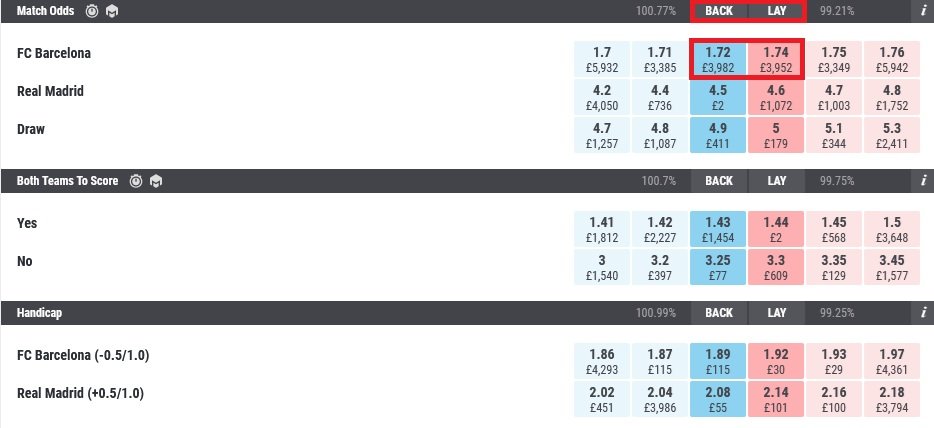
Every betting exchange displays an order book showing:
- Best available back odds — the highest odds currently offered to backers
- Best available lay odds — the lowest odds currently offered to layers
- Available liquidity — the total amount available to be matched at each price
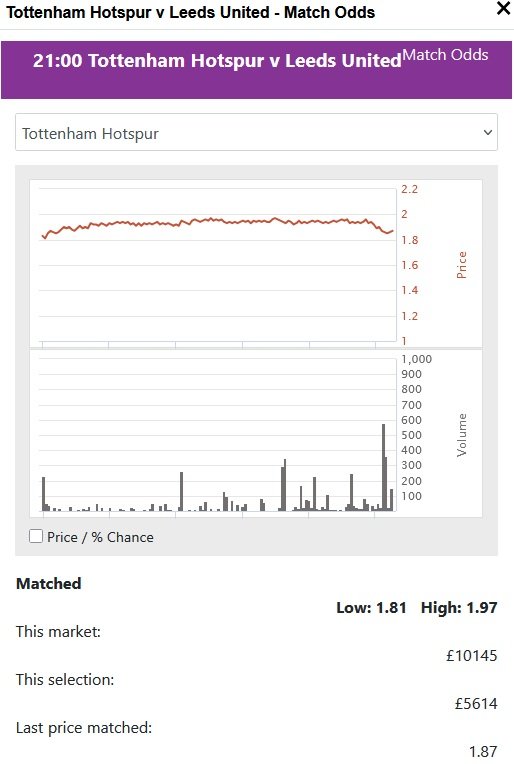
As shown in the Betdaq ladder above, you can see the ‘order book’ in real-time.
Bettors can either accept the current best odds (market order) or request their own price and wait for it to be matched (limit order). This dynamic creates a truly competitive pricing environment where the odds reflect the collective wisdom and activity of all participants.
Price Discovery and Market Efficiency
Because thousands of informed bettors set prices on a betting exchange, the odds tend to be highly efficient. Sharp bettors, professional traders, and syndicates all compete to find value, which naturally drives prices toward fair value. This is why exchange odds are widely regarded as the most accurate reflection of true probability in sports betting.
Popular Betting Exchanges in 2026
Several betting exchanges operate globally, each with different strengths in terms of liquidity, markets, and commission structures.
Betfair Exchange
Founded in 2000, Betfair is the world’s largest and most well-known betting exchange. The platform dominates global exchange betting with unrivalled liquidity across sports including football, horse racing, tennis, cricket, and golf. Its standard commission is 2–5% depending on your market base rate, with discounts available through the Premium Charge and loyalty schemes.
Smarkets
Smarkets is a London-based betting exchange known for its low commission rate, typically 2% on net winnings. While its liquidity is smaller than Betfair, Smarkets has grown significantly and offers a clean, easy-to-use interface popular with recreational exchange bettors.
Matchbook
Matchbook is another betting exchange that competes primarily on commission rates, charging as low as 1.5% on sports markets. It is particularly popular for horse racing and football exchange betting.
Betdaq
Betdaq is one of the oldest betting exchanges after Betfair and is now owned by Ladbrokes. It offers competitive commission rates and reasonable liquidity in major markets, making it a solid alternative for exchange betting.
Betting Exchange Commission Explained
The commission charged by a betting exchange is how the platform makes money, replacing the bookmaker’s overround. Understanding commission is critical when evaluating your profitability on a betting exchange.
How Commission Works
Commission is charged as a percentage of your net winnings on a market, not on every winning bet. This means:
- If you win £100 on a market and the commission rate is 5%, you pay £5 commission
- If you lose money on a market, you pay no commission
- Commission is only charged on net profit per market, not per bet
Commission Rates Comparison
| Exchange | Standard Commission |
|---|---|
| Betfair | 2% – 5% |
| Smarkets | 2% |
| Matchbook | 1.5% – 2% |
| Betdaq | 2% |
Premium Charges
Some platforms, notably Betfair, apply additional charges to consistently profitable bettors. Betfair’s Premium Charge applies to bettors who have won large amounts historically but paid relatively little commission, effectively capping the advantage of highly profitable exchange traders.
Benefits of Using a Betting Exchange
There are compelling reasons why millions of bettors worldwide have switched to exchange betting. Here are the most significant benefits of using a betting exchange:
1. Better Odds
Because the bookmaker’s margin is removed from the equation, betting exchange odds are typically 5–30% more generous than traditional bookmaker odds. Over time, this difference has a dramatic impact on long-term returns.
2. Ability to Lay Bets
No other platform gives you the ability to bet against an outcome quite like a betting exchange. Laying opens up entirely new strategies, from trading markets to hedging positions.
3. In-Play Trading
Betting exchanges offer the deepest and most liquid in-play markets available anywhere. You can back and lay the same selection as a match progresses, locking in profits or cutting losses regardless of the final result.
4. No Account Restrictions
Traditional bookmakers routinely restrict or close the accounts of winning bettors. Betting exchanges have no incentive to do this because they profit from commission regardless of who wins. This makes exchange betting the natural home for serious and professional bettors.
5. Transparency
The betting exchange order book shows you exactly how much money is available at every price level. This transparency is impossible at a traditional bookmaker and helps you make better-informed betting decisions.
6. Price Control
On a betting exchange, you can request your own odds rather than accepting the bookmaker’s price. If you believe a selection is worth 3.50 rather than the current 3.20, you can place a bet at 3.50 and wait for the market to come to you.
Risks and Disadvantages of Betting Exchanges
While exchange betting offers clear advantages, it also comes with risks and limitations that every bettor should understand.
1. Lay Liability Can Be Substantial
When laying high-odds selections, your liability can far exceed your potential winnings. Poor liability management is one of the leading causes of large losses for new exchange bettors.
2. Liquidity Can Be Low in Minor Markets
Betting exchanges thrive on volume. In obscure sports or lower-league fixtures, there may simply not be enough money in the market to get your bet matched. This is less of a problem on major markets but can be limiting for niche betting.
3. Commission Reduces Returns
While exchange odds are better than bookmaker odds, the commission on winnings reduces your effective return. For very small bettors or recreational punters, the complexity of commission accounting can be confusing.
4. Learning Curve
Exchange betting has a steeper learning curve than traditional betting, particularly around concepts like lay betting, liability, and in-play trading. New bettors should start small and invest time in understanding how the platform works before committing significant funds.
5. Premium Charges on Betfair
Highly profitable Betfair customers may eventually be subject to premium charges that significantly increase their effective commission rate. This is a concern primarily for professional traders rather than recreational bettors.
Betting Exchange Strategies for Beginners
Now that you understand what exchange in betting means, it helps to know how bettors actually use exchanges to generate profit. Here are the most accessible and commonly used betting exchange strategies.
1. Value Backing
The simplest exchange strategy is to back selections where you believe the exchange odds represent genuine value — that is, where the implied probability is lower than your assessed probability of the outcome occurring. The higher odds on exchanges compared to bookmakers make value backing more achievable.
2. Lay the Draw Strategy
One of the most popular exchange betting strategies is the lay the draw approach in football. You lay the draw at the start of a match. If a goal is scored, the draw price drifts higher, and you can back the draw at a higher price to lock in a profit regardless of the final result. This is a classic in-play exchange trading strategy.
3. Back-to-Lay Trading
Back-to-lay is an exchange trading strategy where you back a selection at high odds before the event, then lay the same selection at shorter odds as the market moves. The difference between your back price and your lay price represents your guaranteed profit.
Example:
- Back a horse at 8.0 during the pre-race period.
- The horse shortens in the market to 5.0
- Place a lay bet on the same horse at 5.0 once the price drops.
- This locks in a guaranteed profit regardless of the final result.
4. Scalping
Scalping on a betting exchange involves making small, repeated profits from tiny movements in odds. Scalpers trade large volumes and aim to profit from the spread between back and lay prices. This is a sophisticated strategy best suited to experienced exchange traders.
5. Dutching via an Exchange
Dutching involves backing multiple selections in the same market to guarantee a consistent return across outcomes. On a betting exchange, where odds are better, dutching can be more profitable than on traditional bookmakers.
In-Play Betting on a Betting Exchange
One of the most exciting aspects of exchange betting is the ability to bet in-play — while an event is actually taking place. Betting exchanges offer far superior in-play markets compared to traditional bookmakers because prices are set by the market, not by a team of traders, allowing for rapid and accurate price movements.
Why In-Play Exchange Betting Is Unique
In-play betting on a betting exchange allows you to:
- React to events as they happen (goals, red cards, injuries)
- Trade in and out of positions multiple times during a match
- Lock in profits before the event ends
- Cut losses if your pre-match assessment proves incorrect
In-Play Liquidity
Liquidity in exchange in-play markets can be enormous for major events. Premier League matches, Grand Slam tennis, and major horse races attract millions of pounds of in-play trading on platforms like Betfair, providing tight spreads and fast execution even for large bets.
Is Exchange Betting Legal?
Exchange betting is legal in the majority of regulated gambling jurisdictions, including the United Kingdom, Ireland, Australia, and many European countries. Betting exchanges operating in these markets hold valid gambling licences from their respective regulatory authorities.
In the UK, for example, Betfair Exchange is fully licenced by the UK Gambling Commission and regulated under the Gambling Act 2005. Bettors in the UK can use any licenced betting exchange without legal concern.
However, exchange betting is prohibited or unregulated in some jurisdictions. In the United States, exchange betting has historically been limited, though regulatory changes at the state level are expanding access. In some countries, all forms of online gambling — including exchange betting — remain prohibited.
Always verify the legal status of betting exchanges in your country before registering an account.
How to Get Started on a Betting Exchange
If you are ready to try exchange betting for the first time, here is a practical step-by-step guide.
Step 1: Choose a Reputable Betting Exchange
Select a licenced and reputable betting exchange appropriate for your jurisdiction. Betfair is the safest starting point due to its deep liquidity, regulatory standing, and extensive educational resources. Smarkets is a good alternative if you prefer a simpler interface.
Step 2: Register and Verify Your Account
Create an account, provide the required personal details, and complete identity verification (KYC). This is a regulatory requirement on all licenced betting exchanges.
Step 3: Fund Your Account
Deposit funds using your preferred payment method. Most betting exchanges accept debit cards, bank transfers, and popular e-wallets. Start with an amount you are comfortable losing while learning.
Step 4: Understand the Interface
Before betting real money, spend time exploring the exchange interface. Study the order book, understand how to place back and lay bets, and familiarise yourself with the commission structure.
Step 5: Start with Simple Back Bets
Begin by placing simple back bets on sports you know well. Resist the temptation to lay or trade until you are fully comfortable with how the exchange operates.
Step 6: Learn Lay Betting Carefully
When you are ready to try lay betting, start with low-odds selections to keep your liability manageable. Practice calculating your liability before placing any lay bet.
Step 7: Track Your Results
Keep a detailed record of every bet, including the odds, stakes, commission paid, and profit or loss. Tracking is essential for identifying strengths and weaknesses in your exchange betting approach.
Frequently Asked Questions
What is exchange in betting?
Exchange in betting refers to a peer-to-peer betting platform where bettors trade directly with one another rather than against a bookmaker. One bettor backs an outcome while another lays the same outcome, with the exchange acting as the intermediary and charging a commission on winnings.
Is a betting exchange better than a bookmaker?
For most serious bettors, a betting exchange offers better odds, more flexibility, and no account restrictions. However, betting exchanges require more knowledge to use effectively, particularly around lay betting and commission calculations.
What does it mean to lay a bet on an exchange?
To lay a bet on a betting exchange means to bet that a specific outcome will NOT happen. You are acting as the bookmaker, taking the opposing side of a back bet. If the outcome you have laid does not occur, you keep the backer’s stake. If it does occur, you pay out at the agreed odds.
How does commission work on a betting exchange?
Commission on a betting exchange is charged as a percentage of your net winnings on a market, not on every winning bet. If you lose money in a market, you pay no commission. The commission rate varies by platform but typically ranges from 1.5% to 5%.
Can you make money from exchange betting?
Yes, many bettors and professional traders make consistent profits from exchange betting. The better odds, ability to lay, and in-play trading opportunities create genuine edges that are unavailable through traditional bookmakers. However, profitability requires skill, discipline, and sound bankroll management.
What is the biggest betting exchange in the world?
Betfair Exchange is the world’s largest betting exchange by liquidity and trading volume. Founded in 2000 and headquartered in the UK, Betfair processes billions of pounds in bets annually across hundreds of sports markets.
Can I use a betting exchange on my phone?
Yes. All major betting exchanges including Betfair, Smarkets, and Betdaq offer mobile apps for iOS and Android, as well as mobile-optimised websites. In-play exchange betting is fully supported on mobile devices.
What sports can I bet on at a betting exchange?
Betting exchanges cover a wide range of sports including football, horse racing, tennis, cricket, basketball, golf, cycling, darts, rugby, and more. Betfair in particular offers one of the broadest sports betting exchange selections available anywhere.
Summary: What Is Exchange in Betting?
To summarise everything covered in this guide: a betting exchange is a peer-to-peer marketplace where bettors trade directly with each other on sporting outcomes, with the platform charging commission on net winnings rather than building a margin into the odds.
Exchange betting gives you the ability to back selections you think will win and lay selections you think will lose. It offers better odds than traditional bookmakers, complete transparency, in-play trading opportunities, and no account restrictions for winning bettors.
Whether you are a recreational bettor looking for better value or an aspiring professional trader, understanding what exchange in betting means — and how to use it — is one of the most valuable steps you can take in your betting journey.