What is Back and Lay in Betting?
If you are new to betting exchanges or matched betting, you have almost certainly come across the terms back and lay. So what is back and lay in betting, exactly?
In simple terms, backing a bet means you are betting that something will happen — the traditional way most people think of placing a wager. Laying a bet is the opposite: you are betting that something will not happen, effectively taking on the role of the bookmaker.
Together, these two positions form the foundation of how betting exchanges like Betfair, Smarkets, and Matchbook operate. Instead of placing a bet against a bookmaker, you place it against another bettor. One person backs an outcome; the other lays it. The exchange simply connects the two sides and takes a small commission on winning bets.
Understanding this mechanism is essential if you want to use strategies like matched betting, trading, or arbitrage on exchanges — all of which depend on the ability to take both sides of the same selection.
Understanding these mechanisms is the first step toward advanced profit strategies. If you want to see how this works in practice to lock in guaranteed returns, check out our full guide on What is Arbitrage in Betting?
What Does It Mean to Back a Bet?
Backing a bet is exactly what most people do when they visit a traditional bookmaker. You choose an outcome — a team to win, a horse to finish first, a player to score — and you stake money on it happening. If it does happen, you collect your winnings at the agreed odds. If it does not, you lose your stake.
This is the standard form of betting that has existed for centuries. When you back a selection, you are the punter and the bookmaker (or in exchange terms, the layer) is on the other side of the bet.
Back Betting Example
You back Manchester City to win at odds of 2.00 with a £50 stake.
- If Manchester City win: you receive £100 (your £50 stake returned plus £50 profit)
- If Manchester City do not win: you lose your £50 stake
The risk is always capped at the amount you stake. That is one reason backing is simpler and more intuitive for beginners than laying.
What Does It Mean to Lay a Bet?
Laying a bet is the other side of the same coin — and the concept that makes exchange betting so powerful. When you lay a bet, you are betting that a specific outcome will not happen. You are essentially acting as the bookmaker, accepting someone else’s back bet.
If the outcome you laid does not happen — meaning the selection loses — you keep the backer’s stake as profit. If the outcome does happen — meaning the selection wins — you must pay out the backer’s winnings. This payout is known as your liability.
Lay Betting Example
You lay Manchester City to win at odds of 2.00. The backer stakes £50.
- If Manchester City do not win: you keep the £50 stake as profit
- If Manchester City win: you pay out £50 to the backer (your liability at odds of 2.00 minus the £50 stake)
The key difference from backing is that your potential loss (the liability) can be higher than the potential gain (the stake). This is why understanding liability is critical before placing a lay bet.
Real-World Example: Laying the Draw
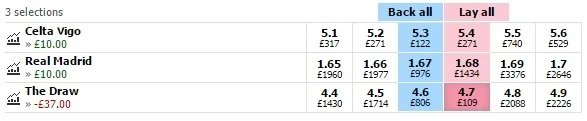
The Scenario: Imagine you are looking at the match between Celta and Real Madrid. You decide to “lay” the draw, meaning you are betting that the game will not end in a draw.
The Numbers:
- Lay Odds: 4.7
- Backer’s Stake: £10
- Your Liability: £37
How the Payout Works:
- If Celta wins or Real Madrid wins: You win £10 (you keep the backer’s stake as profit).
- If the match ends in a draw: You lose £37. This is your liability, calculated as: £10 Stake × (4.7 Odds – 1).
Back and Lay Betting: Key Differences
Here is a clear side-by-side comparison to illustrate the core differences:
| Back Bet | Lay Bet | |
|---|---|---|
| You are betting that… | Something will happen | Something will not happen |
| Your role | Punter | Bookmaker |
| Maximum profit | Stake × (Odds − 1) | The backer’s stake |
| Maximum loss | Your stake | Liability = Stake × (Odds − 1) |
| Risk profile | Lower — loss is capped at stake | Higher — liability grows with odds |
| Available at | Bookmakers and exchanges | Exchanges only |
The single most important practical difference: back bets are available almost everywhere, while lay bets are exclusive to betting exchanges.
How Betting Exchanges Work
To fully understand back and lay in betting, you need to understand the platform that makes it possible: the betting exchange.
A traditional bookmaker sets odds and takes the other side of every bet themselves. They profit from the overround — the margin built into their odds. A betting exchange does not do this. Instead, it acts as a marketplace where bettors trade with each other. One user backs an outcome; another lays it. The exchange matches these two positions and charges a small commission (typically 2–5%) on net winnings.
This model has several advantages for bettors:
- Odds on exchanges are generally better than those offered by traditional bookmakers, because there is no overround — just a commission
- You can lay any selection, giving you far more flexibility in strategy
- You can trade in and out of positions before an event ends, locking in profit or cutting losses
The biggest and most well-known exchange is Betfair, launched in 2000. Others include Smarkets, Matchbook, and Betdaq. Each operates on the same principle.
Back and Lay Example Explained
Let us walk through a complete back and lay betting example to make the mechanics crystal clear.
Scenario: Horse Racing
A horse called Silver Arrow is running in the 3:00 race at Cheltenham. On Betfair, the market shows:
- Back odds: 5.00
- Lay odds: 5.10
You decide to back Silver Arrow with £20 at 5.00.
- If Silver Arrow wins: you receive £80 profit (£20 × 4) plus your £20 stake back = £100 total
- If Silver Arrow loses: you lose your £20 stake
Meanwhile, another user on the exchange lays Silver Arrow at 5.00 with a £20 back stake matched.
- If Silver Arrow does not win: the layer keeps £20 profit
- If Silver Arrow wins: the layer pays out £80 (the liability at odds of 5.00 minus the original stake)
This is how back and lay betting works at a fundamental level — two bettors, two opposing positions, one exchange connecting them.
Trading the Market
One of the most powerful uses of holding both sides of a position is pre-event or in-play trading. If you back Silver Arrow at 5.00 and odds shorten to 3.00 as the race approaches, you can lay Silver Arrow at 3.00 to lock in a guaranteed profit regardless of the result. This is called “green up” — a trading technique only possible because of the back and lay structure.
Liability in Lay Betting
Liability is the amount of money you stand to lose if a lay bet goes against you — and it is the most important number to calculate before placing any lay bet.
How to Calculate Lay Liability
Liability = Lay Stake × (Lay Odds − 1)
Example: You lay a selection at odds of 6.00 and the backer stakes £30.
Liability = £30 × (6.00 − 1) = £30 × 5 = £150
This means if the selection wins, you pay out £150. Your maximum gain, however, is only £30 (the backer’s stake). This asymmetry is why laying high-odds selections carries significant risk — a single winning bet at 10.00 or higher can wipe out many rounds of profit.
Managing Liability
Experienced bettors manage lay liability in several ways:
- Only lay selections at lower odds (below 5.00 is a common guideline) to keep liability proportionate
- Use lay bet calculators before committing to a stake
- Combine lay bets with corresponding back bets (as in matched betting) to hedge the liability
Back and Lay Strategies
These two positions are not just about placing a single wager on each side. There are several established strategies built around the exchange structure:
Matched Betting
Matched betting uses back and lay bets together to extract profit from bookmaker free bets and promotions with zero risk. The free bet is placed as a back at a bookmaker, while the same selection is laid on an exchange to neutralise the risk of the back. The free bet value is then locked in as profit regardless of the outcome.
This is the most popular and beginner-friendly application of back and lay in betting, used by hundreds of thousands of people across the UK and beyond.
Exchange Trading
Exchange trading involves backing and laying the same selection at different odds to lock in a profit before the event ends. If you back a selection at high odds and then lay it at lower odds after odds movement, you make a profit on the spread — similar in principle to financial spread trading.
Scalping
A short-term form of exchange trading where small profits are taken from minor odds fluctuations, often in-play. Requires fast execution and a good understanding of market dynamics.
Dutching with a Lay
Dutching is backing multiple outcomes to spread risk. Combined with a lay on a short-priced favourite, it can create a position where you profit if any of the non-favourite outcomes occur.
Risks of Back and Lay Betting
While exchange betting offers significant strategic flexibility, it also comes with specific risks that bettors should understand before getting started.
Lay Liability Risk
As discussed, laying at high odds can expose you to liabilities many times larger than your potential gain. A poorly placed lay bet on a short-priced favourite that wins can cause significant losses.
Odds Movement Risk
When trading, if odds move against you before you can close your position, you may be forced to close at a loss. Fast-moving markets — particularly in-play — require quick decisions and experience.
Liquidity Risk
Not all markets on exchanges have sufficient matched volume. If your back or lay bet cannot be matched at your desired odds, the strategy breaks down. Lower-profile events and niche sports often have thin markets.
Commission Erosion
Exchange commission (typically 2–5%) applies to net winnings. Over time, this can erode profits — particularly for traders operating on tight margins. Betfair’s premium charge also applies to consistently profitable customers who generate high lifetime profits.
Complexity for Beginners
Back and lay betting is more complex than simply picking a winner at a bookmaker. Beginners who do not fully understand liability calculations risk placing lay bets they cannot afford.
Back and Lay vs Traditional Bookmakers
Many bettors ask whether using an exchange is better than simply using a traditional bookmaker. The answer depends on what you are trying to achieve.
| Betting Exchange | Traditional Bookmaker | |
|---|---|---|
| Lay bets available | Yes | No |
| Odds quality | Generally better (no overround) | Built-in margin reduces value |
| Commission | Yes (2–5% on net winnings) | No — margin is in the odds |
| Account restrictions | Rarely limits winning bettors | Frequently limits sharp bettors |
| In-play trading | Yes — full back and lay in-play | Limited, no position trading |
| Ease of use | More complex | Simple |
| Best for | Matched betting, trading, arbing | Casual betting, promotions |
For recreational bettors who enjoy straightforward wagers, traditional bookmakers are simpler. For those who want to use back and lay strategies consistently, exchanges offer better value, more flexibility, and far less risk of account restriction.
Is Back and Lay Betting Legal?
Yes — back and lay betting is fully legal in all jurisdictions where gambling is regulated. Using a licensed betting exchange like Betfair or Smarkets is no different legally from using any other licensed bookmaker. Exchanges are regulated by the same gambling authorities, including the UK Gambling Commission.
Strategies built on these two positions — including matched betting and exchange trading — are also entirely legal. You are simply placing bets using the tools the platforms provide. No laws exist against using both sides of an exchange market to hedge risk or lock in a profit.
As with all regulated gambling activity, you should ensure you are betting with licensed operators in your jurisdiction and be aware of any tax obligations that may apply to gambling winnings in your country.
FAQs
What is back and lay in betting in simple terms?
Backing means you bet that something will happen. Laying means you bet that something will not happen. Together, back and lay betting is the mechanism that powers betting exchanges — one bettor backs an outcome, another lays it, and the exchange matches them.
Can you back and lay the same selection?
Yes — and this is the basis of matched betting and exchange trading. You back a selection at a bookmaker (or at high exchange odds) and lay the same selection on an exchange to neutralise the risk or lock in a profit on both outcomes.
What is the difference between backing and laying on Betfair?
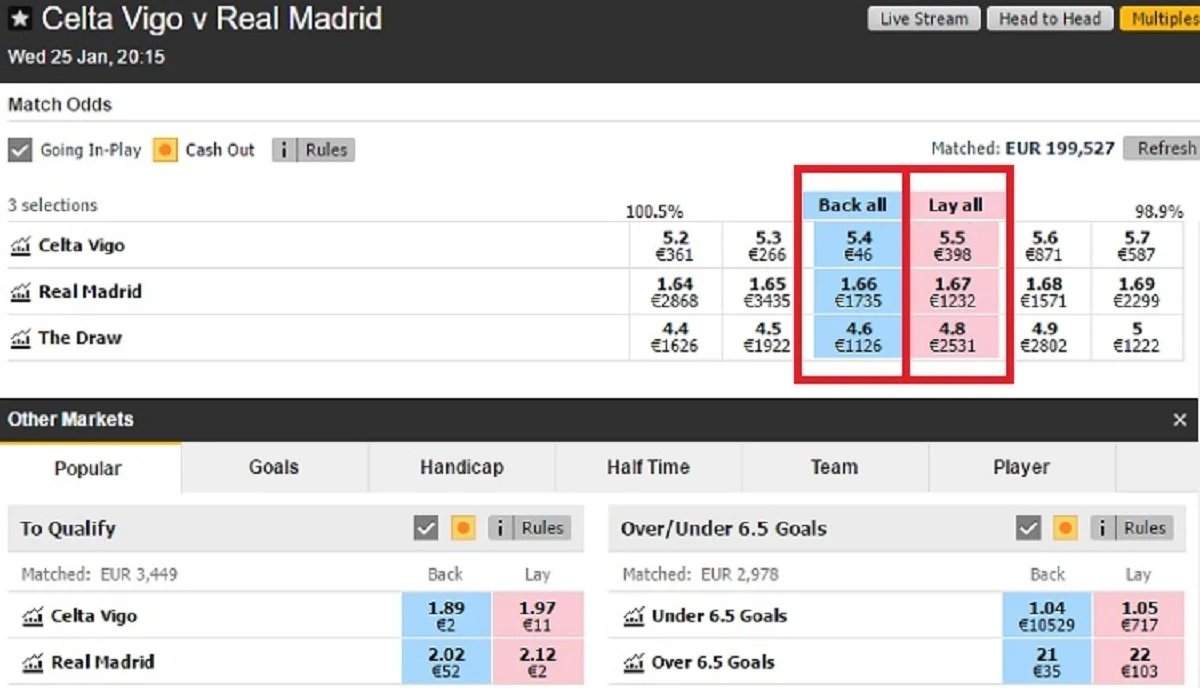
On Betfair, the blue column shows back odds (what you receive if your selection wins) and the pink column shows lay odds (what you accept if acting as the bookmaker). When you back, you take the blue price. When you lay, you take the pink price.
Is laying a bet risky?
It can be. Your maximum loss when laying is the liability — which grows with the odds. Laying a selection at odds of 10.00 with a £20 stake creates a £180 liability. Laying at odds of 2.00 with the same stake creates only a £20 liability. Managing your lay odds and stake size is essential.
Do you need a betting exchange to lay a bet?
Yes. Lay bets are not available at traditional bookmakers. You need an account with a betting exchange such as Betfair, Smarkets, Matchbook, or Betdaq to place lay bets.
What commission do exchanges charge on lay bets?
Commission is charged on net winnings, not individual bets. Betfair’s standard rate is 2% in most markets, though it varies. Smarkets charges around 2%, while other platforms vary. Commission is only deducted when you make an overall profit in a market.
Is matched betting the same as back and lay betting?
Matched betting uses back and lay bets as its mechanism, but they are not the same thing. Back and lay in betting refers to the two sides of an exchange market. Matched betting is a specific strategy that uses both sides together to extract profit from bookmaker free bets and promotions.
Conclusion
Understanding what is back and lay in betting is the gateway to a much wider range of betting strategies than traditional bookmaker wagering allows. Backing is familiar — you are for an outcome. Laying is the opposite — you are against it. Together, these two positions create a flexible market where price, risk, and outcome can all be managed with precision.
Whether you are exploring matched betting for the first time, learning to trade on Betfair, or simply trying to get better odds than bookmakers offer, mastering both sides of the exchange market gives you the tools to do it. Start with backed bets to build confidence, learn liability calculations before placing lay bets, and always use a licensed and regulated exchange.