Learning how to find value in sports betting is the single most important skill that separates long-term winning punters from those who consistently lose. Every professional bettor, trading syndicate, and sharp sports investor operates on the same foundational principle: only bet when the odds available are greater than the true probability of the outcome.
This 2026 guide breaks down exactly how to find value in sports betting, how to calculate it, and how to build a systematic approach that gives you a genuine mathematical edge over the long run.
What Is Value in Sports Betting?
Value in sports betting exists when the odds offered by a bookmaker or betting exchange are higher than the true probability of an outcome occurring. In other words, a value bet is one where you are being paid more than you should be for the risk you are taking.
Think of it this way: if you flip a fair coin, the true probability of heads is 50%, which in decimal odds equals 2.00. If a bookmaker offers you odds of 2.20 on heads, you have found value — the bookmaker is offering you better odds than the true probability warrants. Over thousands of such bets, you would generate a profit.
This concept is the bedrock of how to find value in sports betting. Value has nothing to do with which team you think will win. A bet on a heavy favourite can be excellent value; a bet on a massive underdog can be terrible value. Value is entirely defined by the relationship between the odds you receive and the true probability of the outcome.
The Value Betting Formula
The simplest way to define value mathematically is:
Value = (Your Estimated Probability × Decimal Odds) – 1
- If the result is greater than 0, the bet has positive expected value (+EV) — it is a value bet
- If the result is equal to 0, the bet is fair — no edge either way
- If the result is less than 0, the bet has negative expected value (–EV) — you are paying too much

Example:
- You estimate Liverpool has a 55% chance of winning (0.55)
- The bookmaker offers odds of 2.10
- Value = (0.55 × 2.10) – 1 = 1.155 – 1 = +0.155
- This is a positive value bet with an expected value of +15.5% per unit staked
Why Finding Value Is the Key to Profitable Betting
Most recreational bettors focus on picking winners. Professional bettors focus on finding value. This distinction is crucial — and misunderstanding it is why the vast majority of sports bettors lose money over time.
The Expected Value (EV) Betting Principle
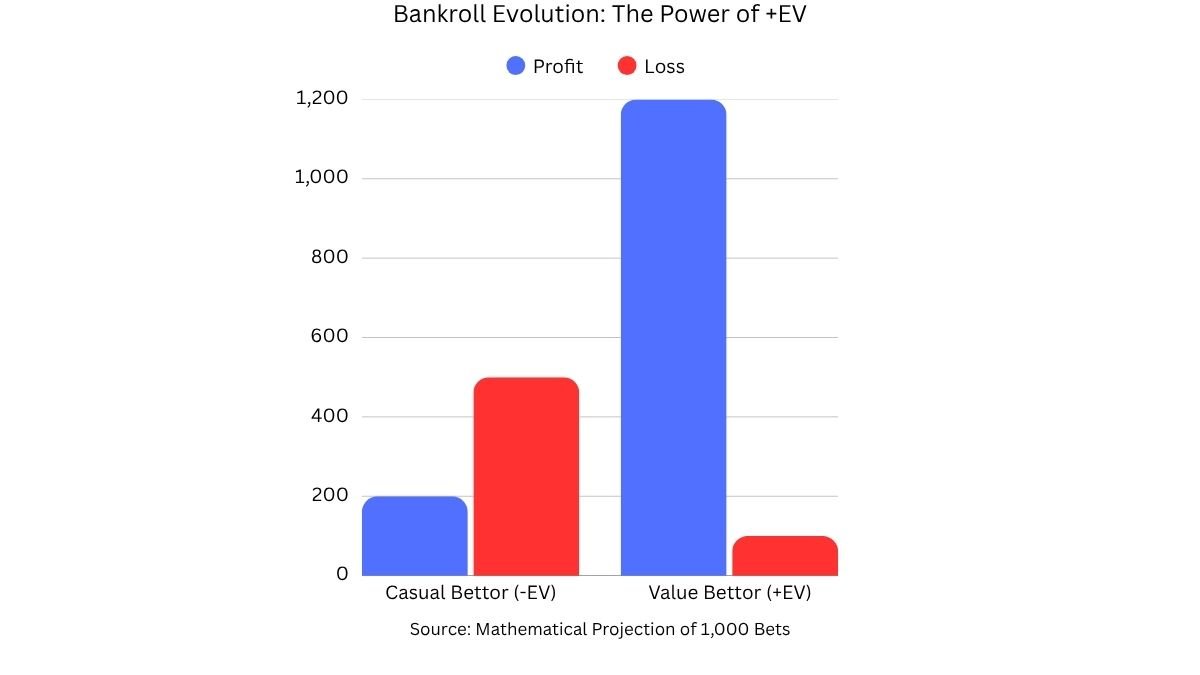
In professional circles, this is known as EV betting. Every wager carries an expected value (EV), representing the average amount you can expect to win or lose per unit staked over a large sample of identical bets. If you consistently place bets with negative expected value, you will lose money in the long run regardless of short-term luck. If you consistently place bets with positive expected value, you will profit over a sufficient sample size.
This is not a theory — it is mathematical certainty. It is precisely why casinos, which build a house edge into every game, always profit over time, and why bettors who understand how to find value in sports betting can replicate that edge on the other side.
The Bookmaker’s Built-In Advantage
Bookmakers price every market with a margin (also called overround or vig) built into the odds. This margin ensures that even if bookmakers priced every outcome perfectly, they would still profit simply because the odds they offer are slightly shorter than true fair-odds prices.
For example, in a two-outcome market (Team A vs Team B), a fair-odds market would sum to 100% implied probability. A bookmaker might price the same market at 105% implied probability — the extra 5% is their margin. Every time you bet into this margin without accounting for it, you are starting with a statistical disadvantage.
Finding value in sports betting means identifying occasions where the bookmaker has mispriced a market — where the true probability of an outcome is higher than the odds imply — and exploiting those errors consistently.
How to Calculate Value in Sports Betting
Before you can find value bets, you need to be able to calculate value precisely. Here is a complete framework for value calculation in sports betting.
Step 1: Convert Odds to Implied Probability
Every set of odds implies a probability. To convert decimal odds to implied probability:
Implied Probability (%) = (1 ÷ Decimal Odds) × 100
| Decimal Odds | Implied Probability |
|---|---|
| 1.50 | 66.7% |
| 2.00 | 50.0% |
| 2.50 | 40.0% |
| 3.00 | 33.3% |
| 4.00 | 25.0% |
| 6.00 | 16.7% |
| 10.00 | 10.0% |
Step 2: Estimate Your Own True Probability
This is where skill and research come in. You must independently assess the probability of the outcome before looking at the bookmaker’s odds. Your estimate must be based on data, form, statistics, and contextual factors — not on gut feeling.
Step 3: Compare Your Probability to the Implied Probability
If your estimated probability is higher than the bookmaker’s implied probability (after removing the margin), you have found a value bet.
Example:
- Bookmaker odds on draw: 3.60 (implied probability: 27.8%)
- Your estimated probability of a draw: 35%
- Value = (0.35 × 3.60) – 1 = 1.26 – 1 = +0.26 (excellent value at +26%)
Step 4: Calculate Expected Value in Money Terms
To understand the expected profit per bet:
Expected Profit = (Probability of Win × Profit if Win) – (Probability of Loss × Stake)
- Probability of win: 35% (0.35)
- Profit if win: £26 (on a £10 stake at 3.60)
- Probability of loss: 65% (0.65)
- Stake at risk: £10
Expected Profit = (0.35 × £26) – (0.65 × £10) = £9.10 – £6.50 = £2.60 per £10 staked
How to Find Value in Sports Betting: Step-by-Step
Now that you understand the theory, here is a practical, actionable framework for how to find value in sports betting on a regular basis.
Step 1: Specialise in a Niche
The single most effective way to find value in sports betting is to become genuinely expert in a narrow area. Bookmakers employ teams of traders to price hundreds of markets daily. You cannot compete with them across the board. But in a small niche — a lower-league football division, a specific tennis circuit, a regional horse racing track — you can develop knowledge that exceeds what the bookmaker’s generalist traders possess.
Choose one sport, one competition, or one market type and go deep. The more specialised your knowledge, the more frequently you will spot mispricings.
Step 2: Build a Pre-Bet Probability Assessment
Never look at the bookmaker’s odds before forming your own probability estimate. Looking at the odds first anchors your thinking to the bookmaker’s view, which is precisely the bias you are trying to overcome.
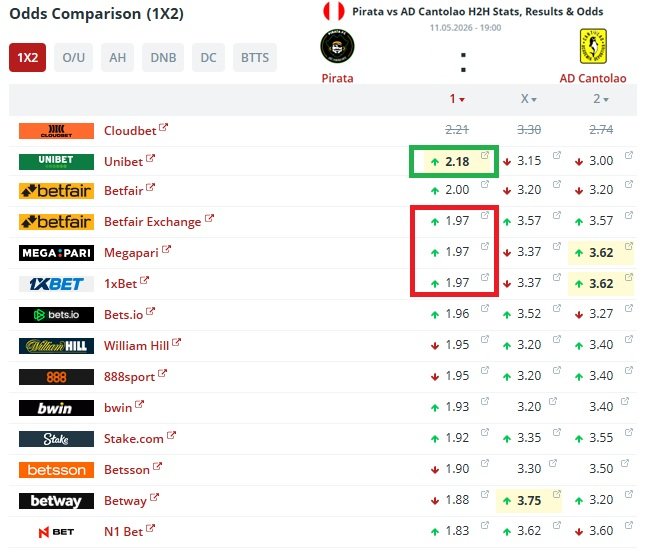
Real-World Value Identification: In this example from the Peru Liga 2, the market consensus for a Pirata home win (represented by the red box) is settled at 1.97. However, Unibet (green box) is misaligned with the rest of the market, offering odds of 2.18. By identifying this 0.21 price discrepancy, a value bettor captures a significant mathematical edge before the market corrects itself.
Instead, research the event independently, assign probabilities to each outcome, and only then compare your assessment to the available odds. If your probability is meaningfully higher than the implied probability in the odds, you have found a potential value bet.
Step 3: Remove the Bookmaker’s Margin
When comparing your probability to the bookmaker’s implied probability, remember to strip out the margin first. A bookmaker offering Team A at 1.90 and Team B at 1.90 in a 50/50 market is not offering fair odds — the true fair price for each would be 2.00. The 1.90 already prices in the bookmaker’s margin.
To remove the margin and find the true implied probability:
- Calculate the implied probability of each outcome
- Sum all implied probabilities (this will be greater than 100%)
- Divide each implied probability by the total to get the margin-adjusted true implied probability
Step 4: Track Every Bet and Measure Your Edge
Keeping detailed records is non-negotiable for value betting. Track the odds, your estimated probability, the outcome, and your actual returns for every bet you place. Over time, this data will tell you whether you genuinely have an edge, where your edge is strongest, and where you are consistently misjudging probabilities.
Without tracking, you are flying blind. With it, you can refine your approach systematically.
Step 5: Be Selective and Patient
Value bets do not appear on every match or every market. Most professional value bettors have win rates of 53–58% on single selections — not much higher than a coin flip. The edge comes not from winning dramatically more often, but from winning slightly more often than the odds imply, consistently over a large sample.
Resist the temptation to bet on every event. Only bet when your analysis shows genuine positive expected value. One high-quality value bet per day beats ten marginal bets.
Understanding Implied Probability and Odds
Mastering implied probability and other essential betting terms is fundamental to finding value in sports betting. It is the bridge between raw odds and meaningful probability analysis.
Decimal, Fractional, and American Odds
Different regions and platforms express odds in different formats, but all can be converted to implied probability.
Decimal Odds (common in Europe, Australia)
- Implied Probability = 1 ÷ Decimal Odds
- Example: 2.50 → 1 ÷ 2.50 = 40%
Fractional Odds (common in UK)
- Implied Probability = Denominator ÷ (Numerator + Denominator)
- Example: 6/4 → 4 ÷ (6 + 4) = 40%
American/Moneyline Odds (common in USA)
- Positive odds: 100 ÷ (American Odds + 100)
- Example: +150 → 100 ÷ 250 = 40%
- Negative odds: |American Odds| ÷ (|American Odds| + 100)
- Example: -200 → 200 ÷ 300 = 66.7%
The Importance of True Probability vs Implied Probability
The gap between your estimated true probability and the bookmaker’s implied probability (margin-adjusted) is where value lives. Value betting is a constant exercise in probability estimation: the more accurately you can assess true probabilities across a range of outcomes, the more reliably you will find value in sports betting markets.
Building Your Own Probability Models
One of the most powerful approaches for finding value in sports betting at scale is building a statistical probability model. Rather than assessing each game subjectively, a model generates objective probability estimates based on historical data and performance metrics.
What Is a Betting Model?
A betting model is a mathematical framework that takes input data (team form, goals scored, defensive records, home/away splits, head-to-head records, etc.) and outputs probability estimates for each possible outcome of a sporting event.
When your model’s probability for a given outcome exceeds the bookmaker’s implied probability (after margin removal), the model flags a value bet.
Simple Poisson Model for Football
One of the most widely used approaches for modelling football matches is the Poisson distribution, which estimates the probability of each scoreline based on each team’s attack and defence strength relative to the league average.
The basic Poisson model works as follows:
- Calculate each team’s average goals scored and conceded per game
- Compute each team’s attack strength and defence weakness relative to the league
- Estimate expected goals for each team in the specific fixture
- Use the Poisson formula to generate a full scoreline probability matrix
- Sum scoreline probabilities to calculate win, draw, and loss probabilities
Even a basic Poisson model, properly calibrated, will identify genuine value bets in football markets with surprising regularity.
Elo Rating Systems
Elo ratings, originally developed for chess, have been successfully adapted to sports betting. An Elo system maintains a continuously updated rating for every team or player based on results, adjusting for the strength of opponents. These ratings can be converted into match probabilities and compared against bookmaker odds to find value.
Regression-Based Models
More sophisticated value bettors use regression models that incorporate dozens of variables — expected goals (xG), possession metrics, shots on target, player availability, travel distance, and more — to generate highly refined probability estimates. Machine learning techniques, particularly logistic regression and gradient boosting, are increasingly used in professional sports betting model development.
How to Find Value Bets in Football
Football is the most heavily traded betting market in the world, which means bookmaker pricing is generally efficient — but not perfectly so. Here is how to find value bets in football specifically.
Focus on Lower Leagues
The Premier League, Champions League, and other top-tier competitions are priced by specialist football traders with access to vast data. Value opportunities exist, but they are rare and small. In lower leagues — the Championship, League One, League Two, lower European leagues — bookmaker attention is thinner, pricing is less precise, and value appears more frequently.
Exploit the Asian Handicap Market
The Asian handicap market eliminates the draw and is priced with smaller margins than the 1X2 (win/draw/win) market. For bettors who know their football, the Asian handicap is often the most efficient market for finding and capturing value.
Analyse Team News and Injury Reports
Bookmakers price markets in advance and adjust as information becomes available, but they cannot always react instantly to team news. When a key player’s absence is confirmed and odds have not yet moved to reflect it, a temporary value opportunity exists. Being first to act on significant team news is one of the most reliable short-term value betting approaches in football.
Use Expected Goals (xG) Data
Expected goals (xG) is a metric that measures the quality of shots taken and conceded, providing a more stable predictor of future performance than raw goals. Teams that consistently outperform their xG are likely due for regression; teams that underperform their xG may be undervalued by bookmakers still pricing on actual results. Using xG data is one of the most accessible ways to find value in football betting today.
How to Find Value Bets in Horse Racing
Horse racing offers some of the richest value betting opportunities in all of sports betting, particularly for bettors who invest time in form analysis and race reading.
The Importance of Going and Conditions
Weather, going (ground conditions), and race-day factors have a profound impact on horse performance that is not always fully priced into the market. A horse with a strong record on soft going may be significantly underpriced when racing conditions turn soft, particularly in lower-profile races where bookmaker attention is limited.
Trainer and Jockey Statistics
Certain trainer-jockey combinations have measurably superior strike rates in specific race types. Bettors who track these statistics and identify when a powerful combination is engaged in a race where the market does not reflect their historical edge can find value on a regular basis.
Pace Analysis
Understanding how a race will be run is a key source of value in horse racing. If a race is likely to be run at a strong early pace that suits off-the-pace runners, horses with a strong late run may be underpriced relative to their true chance of winning.
Early Prices and Morning Lines
Some of the best value in horse racing betting appears early in the morning when bookmakers post initial prices before significant money has been wagered. Sharp bettors who have completed their analysis can sometimes access prices that are substantially better than those available at race time.
Using Statistics and Data to Find Value
Data-driven analysis is the foundation of finding value in sports betting at a professional level. Here is how to build a data-driven approach.
Key Data Sources for Value Betting
- Football: Understat, FBref, WhoScored, Opta — for expected goals, possession, shot data
- Horse Racing: Racing Post, Timeform, At The Races — for form, ratings, going records
- Tennis: Tennis Abstract, Match Stat — for serve and return statistics, surface performance
- Basketball/NBA: Basketball Reference, Cleaning the Glass — for advanced player and team metrics
Building a Ratings Database
Rather than relying on others’ ratings, the most effective value bettors build their own team or player ratings based on objective performance data. Maintaining a live database that is updated after every result allows you to generate match probabilities quickly and compare them to bookmaker prices as soon as markets open.
Backtesting Your Model
Before betting real money with a probability model, backtest it against historical data. Run your model on past seasons, compare the odds it would have recommended backing, and calculate the theoretical returns. If your model shows consistent positive returns over a substantial historical sample, it has demonstrated genuine predictive value.
Backtesting is not foolproof — past performance does not guarantee future results — but it is the most rigorous way to validate a betting model before risking capital.
Line Shopping: Finding Value Across Multiple Bookmakers
Line shopping is the practice of comparing odds across multiple bookmakers and betting exchanges to ensure you always bet at the best available price. It is one of the simplest and most universally effective ways to find value in sports betting.
Why Line Shopping Matters
Even a small difference in odds has a dramatic effect on long-term profitability. Consider a bettor placing 500 bets per year at an average stake of £50. If line shopping consistently finds odds 5% better than the bettor’s usual bookmaker, the additional return amounts to hundreds of pounds per year purely from getting better prices — without any improvement in selection quality.
How to Line Shop Effectively
- Hold accounts at multiple bookmakers and exchanges — at a minimum, have accounts at 3–5 bookmakers plus a betting exchange (Betfair, Smarkets)
- Use odds comparison sites — Oddschecker, OddsPortal, and similar aggregators display prices from dozens of bookmakers side by side
- Always check the exchange price — betting exchange odds frequently exceed bookmaker prices, particularly for major markets
- Act quickly on the best price — odds move constantly and the best prices are often available only briefly
Closing Line Value
Closing line value (CLV) is a professional metric used to measure betting performance. The closing line is the final odds available immediately before an event starts — generally the most efficient price because it incorporates the most information.
If you consistently bet at odds better than the closing line, you are demonstrating genuine skill in finding value bets. Positive CLV is one of the strongest indicators of long-term profitable betting, even if short-term results are variable.
Beating the Bookmaker’s Margin
To consistently find value in sports betting, you must understand the bookmaker’s margin and learn to see through it.
What Is the Bookmaker’s Margin?
The bookmaker’s margin (also called overround, juice, or vig) is the percentage by which the sum of implied probabilities across all outcomes in a market exceeds 100%. This excess is the bookmaker’s built-in profit.
Example — Premier League match:
- Home win: 2.10 (implied probability: 47.6%)
- Draw: 3.40 (implied probability: 29.4%)
- Away win: 3.80 (implied probability: 26.3%)
- Total implied probability: 103.3%
- Bookmaker margin: 3.3%
To break even against this margin, your probability estimates must be at least 3.3% more accurate than the bookmaker’s on every bet. To profit, your edge must exceed the margin.
Margin by Market Type
| Market Type | Typical Bookmaker Margin |
|---|---|
| Match Result (1X2) | 4–8% |
| Asian Handicap | 2–4% |
| Over/Under Goals | 4–6% |
| Both Teams to Score | 5–8% |
| Correct Score | 15–25% |
| Accumulators | Compounds per leg |
This is why professional value bettors avoid markets with high margins (correct score, first goalscorer) and focus on lower-margin markets where their edge needs to be smaller to generate profit.
Value Betting vs Matched Betting vs Arbitrage
Finding value in sports betting is not the same as matched betting or arbitrage, though all three can be profitable. Understanding the differences helps you choose the right strategy for your goals.
Value Betting
Value betting involves identifying and backing selections where your estimated probability exceeds the bookmaker’s implied probability. It requires genuine skill in probability assessment and carries variance — you will go through losing runs even when betting with a genuine edge.
Best for: Serious bettors willing to develop expertise and accept short-term variance for long-term profit.
Matched Betting
Matched betting exploits bookmaker free bet and bonus promotions by backing an outcome with the bookmaker and laying it on a betting exchange, guaranteeing a risk-free profit. This strategy does not require probability assessment skills because the profit is mathematical regardless of the outcome.
Best for: Beginners looking for low-risk introduction to exchange mechanics and betting concepts.
Arbitrage Betting (Arbing)
Arbitrage betting identifies pricing discrepancies between bookmakers where you can back all outcomes at combined implied probability below 100%, guaranteeing a risk-free profit. Like matched betting, it does not require predictive skill.
Best for: Risk-averse bettors comfortable with account management and rapid execution. Note: bookmakers will close or restrict accounts identified as arbers.
Which Strategy Is Best?
Long term, value betting is the most scalable and sustainable approach for generating significant profits from sports betting. Matched betting exhausts promotions over time and arbitrage is limited by account restrictions. Only genuine value betting — rooted in probability skill — can compound profits indefinitely as your ability to find value improves.
Bankroll Management for Value Bettors
Even with a genuine edge in finding value in sports betting, poor bankroll management can bankrupt a winning bettor. A disciplined staking plan is essential.
The Kelly Criterion
The Kelly Criterion is the mathematically optimal staking formula for value betting. It maximises long-term bankroll growth by staking a proportion of your bankroll equal to your perceived edge divided by the odds.
Kelly Formula:
Stake % = (bp – q) ÷ b
Where:
- b = decimal odds – 1 (net profit per unit)
- p = your estimated probability of winning
- q = probability of losing (1 – p)
Example:
- Decimal odds: 3.00 (b = 2)
- Your estimated probability: 40% (p = 0.40)
- Probability of loss: 60% (q = 0.60)
- Kelly stake = (2 × 0.40 – 0.60) ÷ 2 = (0.80 – 0.60) ÷ 2 = 0.10 = 10% of bankroll
Fractional Kelly
Most professional bettors use fractional Kelly — typically staking half or a quarter of the full Kelly recommendation. This reduces variance and protects the bankroll against the inevitable inaccuracies in probability estimation, while still growing the bankroll at a near-optimal rate.
Flat Staking
For bettors who are not yet confident in their probability estimates, a simple flat staking approach — betting the same percentage of bankroll (typically 1–3%) on every value bet — is a safer starting point. Flat staking provides protection against variance and makes performance tracking straightforward.
The Golden Rule: Never Chase Losses
No bankroll management system can protect you from yourself if you abandon it under pressure. Losing runs are a mathematical certainty in value betting — even with a genuine edge, you will regularly experience stretches of 10–20 losing bets. Never increase stakes to recover losses. Trust your edge, follow your staking plan, and let the mathematics work over time.
Common Mistakes That Kill Value Betting Profits
Understanding how to find value in sports betting is only half the battle. Avoiding these common mistakes is what allows you to capture that value in practice.
Mistake 1: Letting the Odds Anchor Your Probability Estimate
Looking at bookmaker odds before forming your own view is the most damaging bias in value betting. Once you see the bookmaker’s price, it becomes extremely difficult to assess probability independently. Always form your view first.
Mistake 2: Betting on Too Many Markets
Spreading your focus across dozens of sports, leagues, and market types dilutes the specialist knowledge that creates value. Depth beats breadth every time. Pick your niche and own it.
Mistake 3: Confusing Outcome with Process
A value bet that loses is still a good bet. A bet without value that wins is still a bad bet. Judge your performance on the quality of your decision-making process — specifically, whether you consistently found odds greater than the true probability — not on whether individual bets won or lost.
Mistake 4: Underestimating Variance
Even with a genuine 5% edge, a run of 30 losing bets from 50 is statistically possible. Bettors who do not understand variance abandon winning strategies during losing runs and switch to losing strategies during winning runs, a behaviour pattern that guarantees long-term losses.
Mistake 5: Ignoring Closing Line Value
If your bets consistently close at shorter odds than you backed, you are demonstrating genuine value-finding skill — even if recent results have been poor. If your bets consistently close at longer odds than you backed, your pricing is weaker than the market’s, regardless of recent results.
Mistake 6: Neglecting Line Shopping
Accepting the first odds you find without checking alternatives is leaving money on the table. Over time, the difference between average odds and best-available odds can be the difference between a profitable and losing record.
Tools and Resources for Finding Value Bets
The right tools can dramatically accelerate your ability to find value in sports betting. Here are the most valuable resources available.
Odds Comparison Tools
- Oddschecker — compares odds from 30+ UK bookmakers instantly
- OddsPortal — international odds comparison with historical closing lines
- Betbrain — strong for European markets and arbitrage identification
Statistical and Data Platforms
- Understat.com — free expected goals (xG) data for major European football leagues
- FBref.com — comprehensive football statistics including advanced metrics
- Racing Post — essential for UK and Irish horse racing form and ratings
- Tennis Abstract — detailed serve/return statistics for professional tennis
Value Bet Finders
- RebelBetting — automated value bet scanner covering major sports
- OddsJam — US-focused value bet and arbitrage finder
- Trademate Sports — professional value betting software with CLV tracking
Spreadsheet and Model Building
- Microsoft Excel / Google Sheets — essential for building and maintaining your own probability models and bankroll tracking
- Python / R — for more advanced statistical modelling and backtesting
Betting Exchanges
- Betfair Exchange — the world’s largest exchange, essential for line shopping and lay betting
- Smarkets — low commission alternative with clean interface
Frequently Asked Questions
How do you find value in sports betting?
Finding value in sports betting requires you to assess the true probability of an outcome independently, convert the bookmaker’s odds to implied probability, and bet only when your estimated probability is higher than the bookmaker’s implied probability (after removing the margin). Specialising in a niche market, building a data-driven approach, and line shopping across multiple bookmakers are the most effective practical strategies.
What is a value bet in sports betting?
A value bet is any bet where the odds offered are greater than the true probability of the outcome warrants. Mathematically, a value bet has positive expected value (+EV), meaning it will generate profit over a large sample of similar bets even if individual results vary.
Can you consistently find value bets?
Yes, but it requires skill, specialisation, and disciplined process. Professional bettors and syndicates consistently find value by developing superior knowledge in specific markets, building accurate probability models, and exploiting pricing inefficiencies before bookmakers adjust. The key is consistent application of a rigorous process rather than relying on intuition.
What sports are easiest to find value in?
Lower-league football, horse racing, and niche tennis tournaments tend to offer the most accessible value betting opportunities because bookmaker pricing in these markets is less precise than in major competitions. The best sport to find value in is ultimately the one you know most deeply.
What is closing line value in betting?
Closing line value (CLV) is the difference between the odds you backed and the final odds available immediately before the event starts. Consistently backing at odds better than the closing line is one of the strongest indicators of genuine value-finding skill, as the closing line represents the most efficient price in the market.
How much of your bankroll should you bet on a value bet?
Most professional value bettors use fractional Kelly staking — typically staking 0.5 to 2.5% of their bankroll per bet, calibrated to the size of their perceived edge. Flat staking at 1–2% per bet is the safest starting point for bettors still developing their probability estimation skills.
Is value betting profitable long term?
Yes. Value betting is the only sports betting strategy that is theoretically and practically capable of generating consistent long-term profits, because it is grounded in a mathematical edge rather than promotion exploitation or arbitrage. The challenge is developing the probability estimation skills to find genuine value consistently and the psychological discipline to trust the process through inevitable losing runs.
How do bookmakers limit value bettors?
Bookmakers routinely restrict or close accounts of bettors who demonstrate consistent positive CLV and profitability. They may reduce maximum stake limits to tiny amounts or refuse to offer certain markets to identified value bettors. This is why using betting exchanges — where profitable bettors are welcomed — is an important part of a long-term value betting strategy.
Summary: How to Find Value in Sports Betting
Finding value in sports betting is not a secret formula or a shortcut. It is a rigorous, skill-based discipline grounded in probability, data, and disciplined process. Here is a recap of the core principles:
- Value exists when the odds available are greater than the true probability of the outcome
- Calculate value using the formula: (Your Probability × Decimal Odds) – 1 > 0
- Form your probability estimate before looking at the bookmaker’s odds
- Specialise in a niche where you can develop knowledge superior to the bookmaker’s pricing
- Build a data-driven model to generate objective probability estimates at scale
- Line shop across multiple bookmakers and exchanges to maximise the odds you receive
- Track closing line value as the primary metric of your value-finding skill
- Manage your bankroll with fractional Kelly or flat staking to survive variance
- Be patient and selective — bet only when genuine value is present
Mastering how to find value in sports betting is a journey that rewards those who invest in knowledge, process, and discipline. As outlined in this 2026 punter’s guide, the edge is real, the mathematics are sound, and for punters willing to do the work, long-term profitability is an achievable goal.